

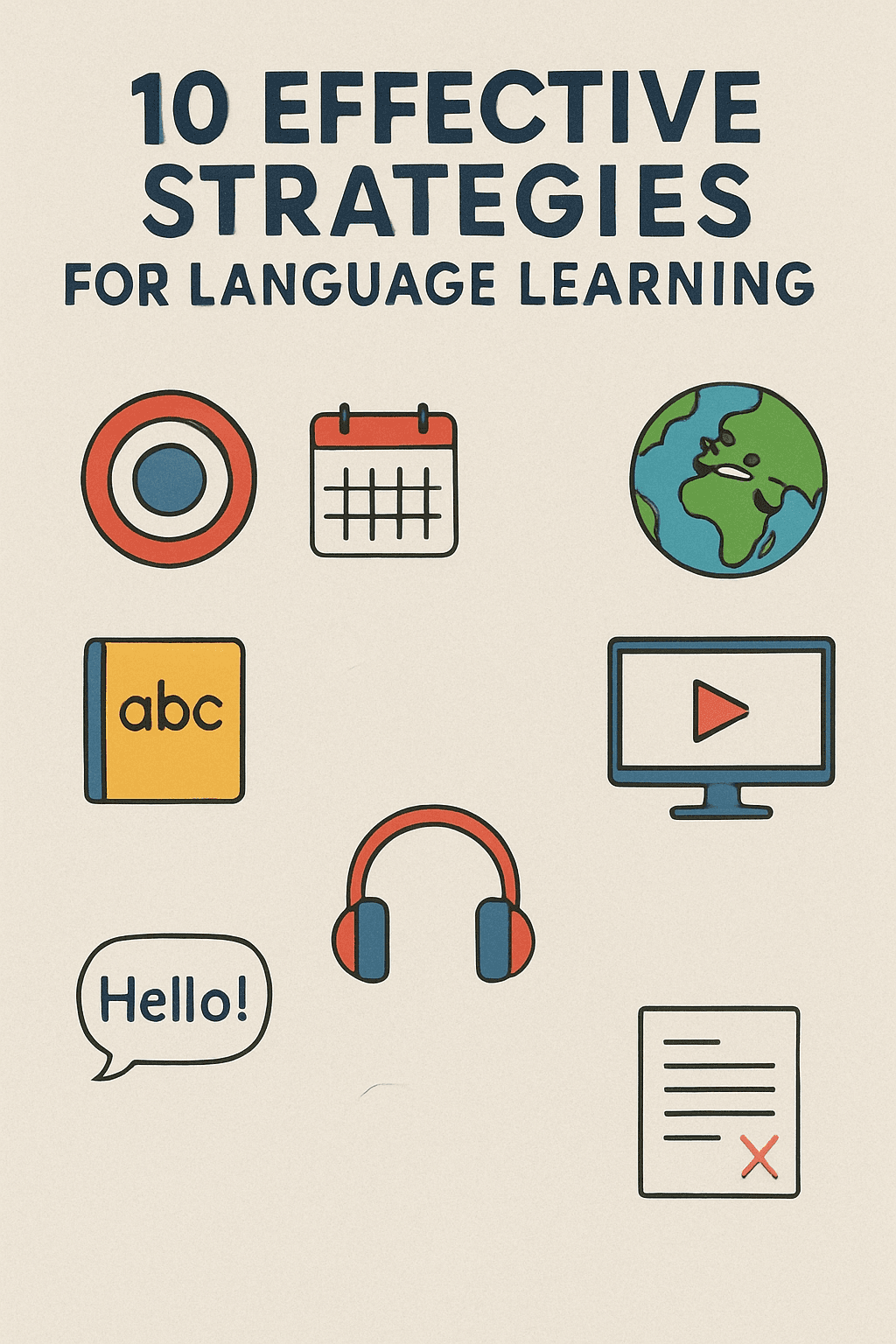
Stop Guessing: 10 Science-Backed Strategies to Finally Master Japanese
We’ve all seen the ads. “Learn Japanese in your sleep!” “Master Kanji in 30 days with this one weird trick!”
It’s tempting to look for a shortcut, especially when you’re staring down the barrel of three different writing systems and grammar that feels backwards. But here’s the truth: most "niche" methods fail because they ignore how the human brain actually processes a second language.
If you feel like you’ve hit a plateau, it’s probably not because you lack talent. It’s because you lack a strategy.
Based on established Second Language Acquisition (SLA) principles, here are 10 fundamental strategies to transition from a frustrated beginner to a confident intermediate speaker.
1. Prioritize "Comprehensible Input"
The single most important concept in language learning is Input + 1. This means you should spend the majority of your time listening to and reading Japanese that you understand about 70–80% of.
If you try to watch a political drama without subtitles as a beginner, your brain just hears noise. You learn nothing. But if you watch a slice-of-life anime or read a "graded reader" where you understand the gist but struggle with a few new words, your brain starts connecting the dots automatically.
2. Embrace the "Silent Period"
There is a massive pressure in the app world to "speak from day one." For some, this works. For many, it leads to burnout and anxiety.
Established research suggests a "Silent Period" is natural. You need to build a mental library of how Japanese sounds and functions before you can produce it accurately. Don't feel guilty if you spend your first few months just absorbing. When you do eventually speak, the words will come more naturally.
3. Use Spaced Repetition (SRS) for Vocabulary
Rote memorization—writing a word 50 times in a notebook—is the least efficient way to learn. Your brain is designed to forget things it doesn't use.
Use a Spaced Repetition System (SRS) like Anki or the built-in trainers in your learning app. These algorithms show you a word exactly when you are about to forget it. This pushes the information from short-term memory into long-term "acquisition."
4. Learn Kanji in Context, Not in Isolation
One of the biggest mistakes learners make is trying to memorize the 2,000+ Jōyō Kanji by looking at individual characters and their "on-yomi" and "kun-yomi" readings.
Stop doing that. You don't learn English by memorizing the Latin roots of every word in the dictionary. Learn Kanji as part of vocabulary words. Instead of learning the character for "Electric" (電), learn the word for "Train" (電車 - densha). The reading becomes intuitive because it’s attached to a real-world object.
5. Focus on High-Frequency Verbs First
Japanese has thousands of verbs, but you only need a fraction of them to handle 80% of daily life.
Instead of getting bogged down in specialized vocabulary (like "to adjourn a meeting"), master the "Big Five": suru (to do), iru/aru (to be), iku (to go), taberu (to eat), and miru (to see). If you can conjugate these perfectly and use them in different contexts, your fluency will skyrocket.
6. Use "Shadowing" for Pitch Accent and Rhythm
Japanese is a pitch-accent language, and its rhythm is "mora-timed" (every syllable gets equal time). This is very different from English.
To sound less like a textbook and more like a person, use Shadowing. Listen to a native speaker and try to repeat exactly what they say at the same time they are saying it. Don't worry about the meaning yet—mimic the rise and fall of their voice and the speed of their delivery.
7. Don’t Let Grammar Be a Speed Bump
Many learners get stuck on the difference between the particles wa (は) and ga (が). They spend weeks reading forums instead of practicing.
Here’s a secret: You will get particles wrong. Native speakers will still understand you. In the beginning, treat grammar as a "map" to help you understand what you're hearing, not a set of rigid laws you must master before you're allowed to talk.
8. Narrow Your Domain (The Power of "Narrow Listening")
If you jump from a news podcast to a cooking show to a samurai movie, you encounter too much "random" vocabulary.
Try Narrow Listening: stick to one topic or one speaker for a week. If you love cooking, watch five different Japanese YouTube videos about making ramen. The vocabulary will overlap, providing natural repetition that helps words stick without you even trying.
9. Interleaving: Mix It Up
While "Narrow Listening" is good for vocabulary, Interleaving is best for long-term retention. This means mixing different types of practice in one session.
Instead of doing 60 minutes of Kanji, do:
- 15 minutes of SRS cards.
- 20 minutes of reading a short story.
- 15 minutes of listening practice.
- 10 minutes of writing simple sentences. This prevents "learner fatigue" and forces your brain to stay sharp.
10. Tolerance for Ambiguity
The most successful language learners have a high "tolerance for ambiguity." They are okay with not understanding every single word in a sentence.
If you stop to look up every word, you break your flow and frustrate yourself. Learn to be okay with "getting the gist." Language learning is a puzzle where the edges are blurry at first. Trust that the more you engage, the clearer the center will become.
Your Immediate Action Plan
You don't need a new "hack." You need to apply these fundamentals. Here is how to start today:
- Audit your time: Are you spending at least 50% of your study time on listening? If not, find a podcast or video at your level today.
- Clear your SRS deck: If you have 500 overdue cards, delete them. Start fresh with high-frequency words you actually want to use.
- Choose a "Domain": Pick one topic (hobbies, work, travel) and commit to only consuming content in that area for the next 7 days.